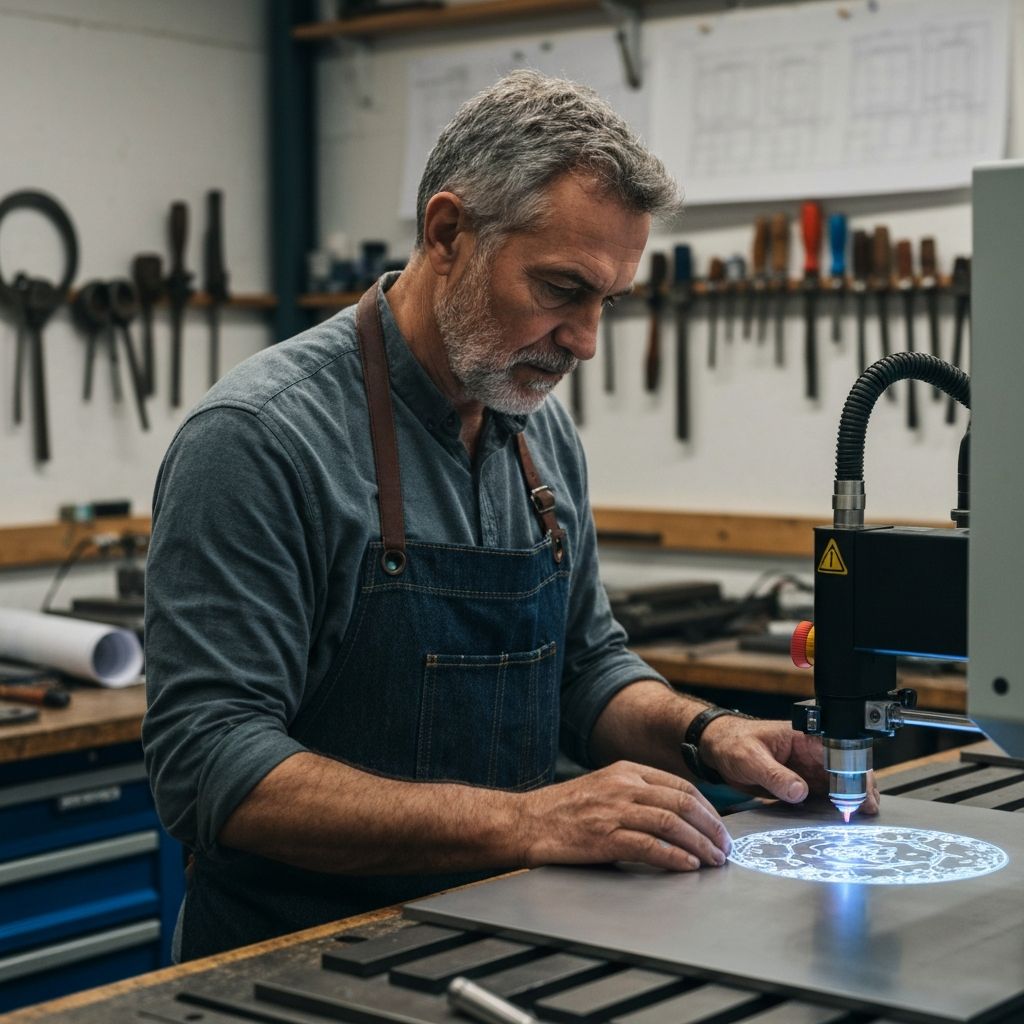
We use AI every day at Let It Be Company — Microsoft Copilot, ChatGPT, and the occasional Grok session. It drafts grant applications, sketches design concepts, and handles the boring writing that used to eat a Saturday. A small veteran-owned shop in Farmersville can now punch above its weight against corporate marketing teams 30 miles down US-380, and AI for small business is the reason why.
Roger reaches for an AI tool four or five times on a normal workday. Not to replace anything. To clear the runway so the actual craft — the engraver, the powder coat oven, the customer on the phone who needs a retirement award by Friday — gets the hours it deserves.
The Numbers Behind a Small Shop Going Big
Here is the landscape we work in. Collin County holds the headquarters of Toyota North America, Frito-Lay, Liberty Mutual, JPMorgan Chase's Plano campus, and JCPenney — five corporate marketing departments with budgets bigger than the GDP of small countries. Princeton, 12 miles from our shop, grew 30.6% in 2024 — the fastest-growing city in America. Celina hit 24.6% the same year. Anna and Melissa keep pace. The DFW Metroplex now has roughly 386,358 veterans, and a chunk of them are starting businesses.
None of that matters if a one-person shop can't produce a polished proposal or a clean product listing in the time it takes a corporate team to schedule a meeting. AI changes the math.
Why "AI Replaces Craftsmen" Gets It Exactly Backwards
The loud take online is that AI is coming for the makers. That gets the picture upside down. AI is the design intern, not the boss. It generates twenty mockups in the time it took us to sketch one. It writes a first-draft product description that we then rip apart and rewrite in plain English. It reads a 40-page grant RFP and pulls the three eligibility lines that actually matter.
What it cannot do: feel the heft of a powder-coated tumbler, tell a customer their logo will look terrible at 0.5 inches, or know that a Vietnam-era veteran wants his ship's hull number engraved next to his name and not above it. That is still a human at a bench, and it always will be. AI saves the boring hours. The craft stays human.
Roger's background in printing, pre-sales engineering, and IT made the jump natural. Most veterans we train pick it up in an afternoon.
The Task-to-Tool Matrix We Actually Use
There is no single AI. Different jobs go to different tools. Here is the shop's working playbook.
| Task | Tool we reach for | Why it wins | Where the human takes over |
|---|---|---|---|
| Grant applications | ChatGPT + Copilot | Structures dense RFP language and drafts narrative sections fast | Every number, every claim, every veteran story — verified by hand |
| Product descriptions & listings | Copilot in Word | Punches out 30 SKU descriptions in an hour, consistent voice | Rewrite for plain English; kill the marketing fluff |
| Design ideation & mockups | Image generators | Twenty layout concepts before lunch; client picks a direction | Final art, kerning, file prep for the laser — done in real software |
| New material or technique research | ChatGPT, then Grok | Faster than a forum thread; flags what to verify | Test on scrap. Always. AI hallucinates settings. |
| Email and customer copy | Copilot in Outlook | Quick, professional replies when the shop is hot | Read it out loud before sending. Sound like a person. |
The Grant-Writing Story
Last year we chased a State of Texas learning grant to help underwrite our veteran training program. Forty-plus pages of narrative, budget tables, outcomes language, the works. The old version of this involved a legal pad, two pots of coffee, and a weekend. Copilot read the RFP, surfaced the three eligibility hooks that fit a Farmersville-based veteran-owned LLC, and laid out a draft outline in twenty minutes. Roger still wrote every sentence that went on the form. The AI just kept the structure honest. That is the loop.
What This Means for Veterans Coming Out
If you are a veteran in North Texas thinking about starting something — a shop, a service, a side gig — the timing is good. Princeton, Anna, Melissa, and Celina are growing faster than local supply can keep up. Corporate HQs in Plano and Frisco pay for nice things. AI for small business removes the excuse that used to stop a lot of guys: "I'm not a writer, I'm not a designer." You do not have to be. You have to know what good looks like and steer the tool toward it.
That is why AI training rides shotgun with the engraver and sublimation training in our veteran program. Hand skill plus AI judgment is a hard combination to beat.
Three Rules for Using AI Without Losing Your Craft
- The tool drafts, the human ships. Never send anything AI wrote without reading every line out loud and rewriting at least a third of it.
- Verify every fact, every setting, every number. AI will confidently invent a laser power setting that ruins a piece of walnut. Test on scrap.
- Keep the customer relationship human. Phone calls, handshakes at the Farmersville Market, follow-ups that mention their kid by name — no AI does that. Do not let it try.
Where to See It in Practice
Most of the work in our gallery went through some AI step — mockup, description, listing copy, or proposal. The hands that finished it were ours. If you want to see how that works for your business, or you are a veteran who wants to learn the loop, drop us a line. We are happy to show what we have learned, and we serve clients across Farmersville, McKinney, Princeton, Plano, Frisco, and the rest of Collin County.