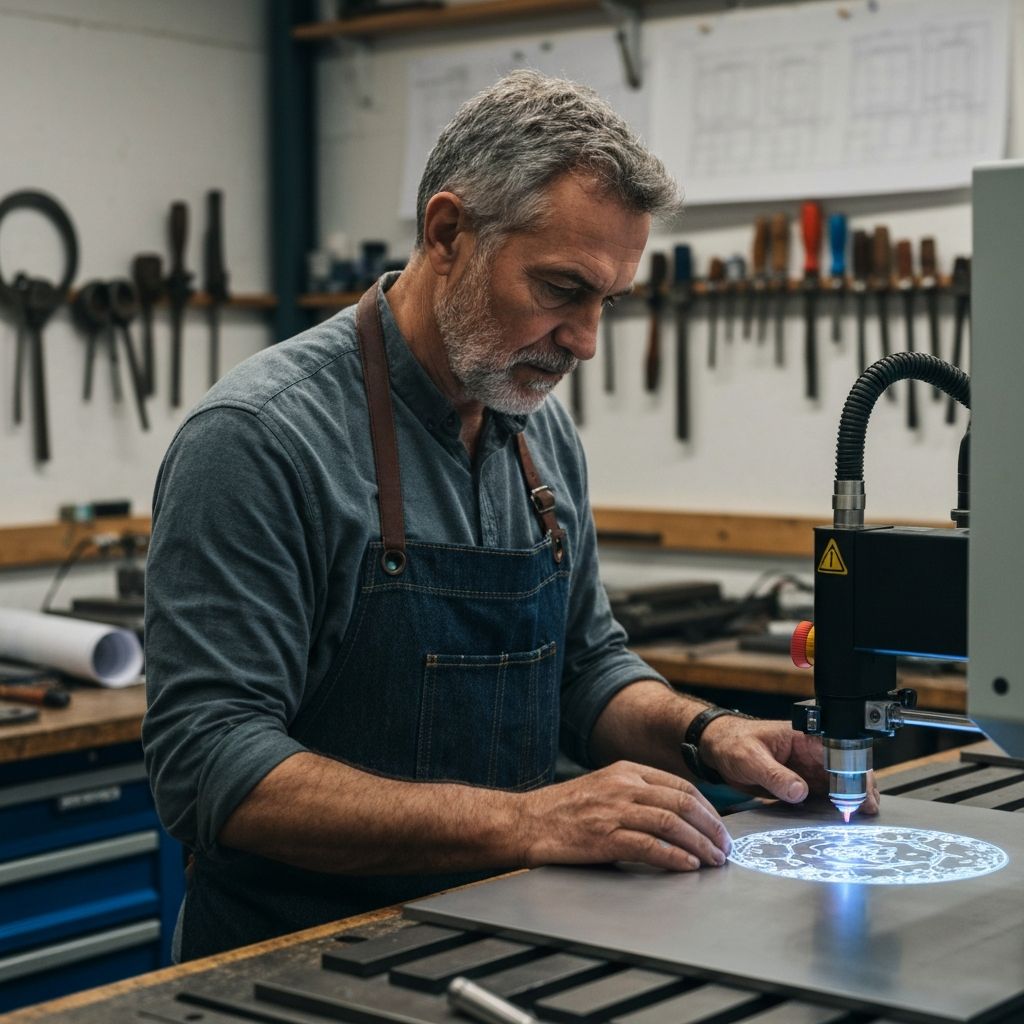
Laser welding training teaches you to fuse metal with a focused beam instead of an electric arc — cleaner welds, less heat distortion, a friendlier learning curve. On an all-in-one platform like the xTool MetalFab, the same machine cuts, engraves, cleans, and welds. For a veteran in Collin County looking at a trade, it is one of the most marketable shop skills on the bench right now.
There is always work for someone who can join metal. The question is which method you learn first, and whether the shop you walk into has the equipment to use it. In North Texas, the answer is shifting fast.
The hard numbers
- 3/8 inch — carbon steel cut depth on the xTool MetalFab platform we are building around
- 800 to 1200 watts — CO2 laser power range that does the heavy lifting on cuts and welds
- 4 capabilities, 1 footprint — cut, engrave, weld, and clean from a single machine
- 386,358 veterans in the DFW Metroplex, roughly 1 in 4 of Texas's 1.6 million
- 150 hours of free tuition available to qualified Texas veterans under the Hazlewood Act, usable at Collin College
What laser welding actually is
A wire-fed laser welder uses a concentrated beam of light to melt the parent metal and a filler wire into a single, fused joint. The heat input is tiny compared to stick or MIG, so you get less warping on thin material, less grinding after the fact, and a bead that looks closer to TIG without the months of muscle memory TIG demands. It scales from delicate stainless work up through heavy structural steel, and the technique even works underwater.
The platform we are bringing to Farmersville does more than weld. The same xTool MetalFab unit cuts carbon steel up to 3/8 inch, engraves marks and serial numbers into metal, runs the wire-fed laser welder, and laser-cleans rust, paint, and contaminants off a surface before you touch it. One machine, paired with an air purifier about the size of a washing machine, replaces what used to take a corner of a shop.
Why laser welding is not replacing traditional welding — and why that is the point
The internet has a habit of declaring every new tool a replacement for the old one. That gets laser welding backwards. A stick welder and a laser welder are not competitors. They are different tools for different jobs.
You cannot drag an xTool MetalFab out to a ranch gate, a pipeline, or the underside of a trailer. For mobile field work, traditional welding rigs win, and they always will. What the laser welder owns is shop-based fabrication where precision, low heat input, and finish quality matter — automotive prototyping, aerospace subassemblies, custom signage, decorative panels, and small-batch production work for the Tier 1 and Tier 2 suppliers feeding Toyota North America's Plano headquarters and the broader Collin County manufacturing base.
Learning laser welding does not retire your stick welder. It adds a second tool that pays for jobs the stick welder cannot touch.
Material × capability: what this machine actually does
Spec sheets oversell. Here is the honest matrix on the xTool MetalFab platform — what works, what works with limits, and what you should not ask it to do.
| Material | Cut | Engrave | Weld | Clean |
|---|---|---|---|---|
| Carbon steel (up to 3/8") | Yes | Yes | Yes | Yes |
| Stainless steel | Yes, with limits on thickness | Yes | Yes | Yes |
| Aluminum | With limits — reflectivity is the enemy | Yes | Yes, with limits | Yes |
| Painted or rusted metal | Clean first, then cut | With limits | Clean first, then weld | Yes — this is the killer feature |
The cleaning function alone is worth the conversation. Stripping rust and old paint without media-blasting, chemicals, or wire wheels is the kind of upgrade that quietly changes how a small shop quotes restoration work.
A marketable trade for the next generation
Skilled welders stay in demand. Layer laser welding on top of a traditional welding background and you have a credential most shops in the DFW Metroplex do not yet have on staff.
For a veteran transitioning out — Vietnam-era, post-9/11, anyone in between — that is exactly the kind of skill we want to put in your hands through our training program. The bridge to make it affordable already exists: the Collin College Veterans Resource Center in McKinney handles the Hazlewood Act paperwork for up to 150 hours of free tuition, GI Bill processing, and priority registration. We are working alongside Collin College to plug a laser welding and metal fabrication track into that pipeline.
The Collin County economy is built for this. Toyota North America anchors a supplier base across Plano, Frisco, and McKinney. Aerospace and defense subcontractors run throughout the Metroplex. Princeton was the fastest-growing city in the country in 2024. Someone has to fabricate the brackets, signs, gates, and structural pieces that growth needs.
Precision meets creativity
Metal fabrication is not only industrial. The same beam that cuts a structural plate produces custom signs, address plaques, decorative panels, and one-off metal art for businesses around Farmersville and the brick-street downtown square. That blend — tight tolerances on one job, expressive craftsmanship on the next — is the whole point of how we work. You can see the range across our gallery and the product lines we run.
Audie Murphy grew up on a sharecropper's farm a few miles from our shop. The most decorated American combat soldier of WWII asked, on his Arlington headstone, for the same plain GI marker every other soldier gets — not the gold leaf the Medal of Honor authorizes. Quiet precision over showy claims. That is the standard for the work we want to teach.
Three things to know before you learn laser welding
- It is a shop skill, not a field skill. Plan to pair it with traditional welding if you want full coverage of the trade.
- The learning curve is friendlier than TIG, but it is not free. Material setup, focus distance, gas, wire feed, and cleanliness all matter — the laser is forgiving on heat, not on prep.
- The market is local and growing. Collin County's manufacturing and aerospace base, plus the DFW automotive supplier network, means the work is here, not somewhere you have to move for.
Learn with us
We are veteran-owned, Farmersville-based, and 45 miles from downtown Dallas. The equipment is being staged. The Collin College partnership is in motion. If laser welding training, metal fabrication, or a career change into a real trade is on your mind — reach out. We will tell you exactly where the program stands and how to get in line for the first cohort.